

Case Study – Objective Testing for Confirming Asthma

Objective testing is the foundation of accurate asthma diagnosis and effective long-term management. Yet it remains underused, increasing the risk of both overtreatment and undertreatment.1 When a patient does not respond as expected, escalating medication without first reassessing the diagnosis and underlying disease mechanisms can add cost, increase the burden of care, and expose the patient to unnecessary adverse effects. Incorporating objective testing into routine follow-up transforms uncertainty into evidence—and ensures that every treatment decision is targeted, justified, and centered on the patient.
It is only through objective testing that we can be fully confident that we are treating patients properly. It is well known that asthma is heterogeneous and symptoms, triggers and severity can change in patients over time. Going beyond patient reported symptoms is vital in detecting changes in their asthma.
The importance of addressing the four pillars of respiratory diagnosis and management: clinical symptoms, inflammation, airway obstruction and hyperresponsiveness2 will be highlighted by following a real-world patient case study. Reviewing the patient’s history and physical exam yields important information on going, not just during diagnosis. A patient’s level of airway function through spirometry with pre and post bronchodilator responsiveness needs to be assessed annually, after an exacerbation or with medication changes. Assessing airway hyperresponsiveness to a bronchoconstricting agent such as Provocholine® provides insight to the level of smooth muscles activation3. As with Spirometry, a bronchial challenge test can be performed even after diagnosis. A methacholine challenge may provide insight as to why a patient is not responding as expected either by ruling out or confirming airway hyperresponsiveness. Assessing airway inflammation noninvasively with fractional exhaled nitric oxide (FeNO) measurements4 during follow up visits, provides immediate feedback for the provider and patient. Together, the four pillars provide confidence in the diagnostic process and with patient management.
When a patient does not respond to the typical treatment for asthma and is determined to have severe T2 asthma, biologic medications should be considered. Biomarkers are identified to help guide decision making as to which biologic would be best for the patient. Evaluating airway inflammation through FeNO or blood eosinophils, can aide in choosing between an anti-IL4,anti-IL5, Anti-IGE or a nonspecific biomarker medication.
Patient Case Study – highlighting the importance of utilizing objective testing to confirm a diagnosis when a patient does not respond to treatment.
Patient profile – 38-year-old female
Pillar 1, Clinical Symptoms – atopic, never smoked, wheezing, cough with sputum production. Her physical exam is normal. Her current Asthma Control Questionnaire is 2.8. The ACQ scoring is 0-6, a lower score reflects better control. A score of zero is considered totally controlled, a 6 reflects severely uncontrolled asthma5. She is taking prednisone and when weaned below 5mg daily, she reports her breathing is worse. Additionally, she is on an ICS/LABA/LAMA inhaler. She started an IL5 monoclonal antibody three months ago. The patient reports no improvement in her symptoms with treatment.
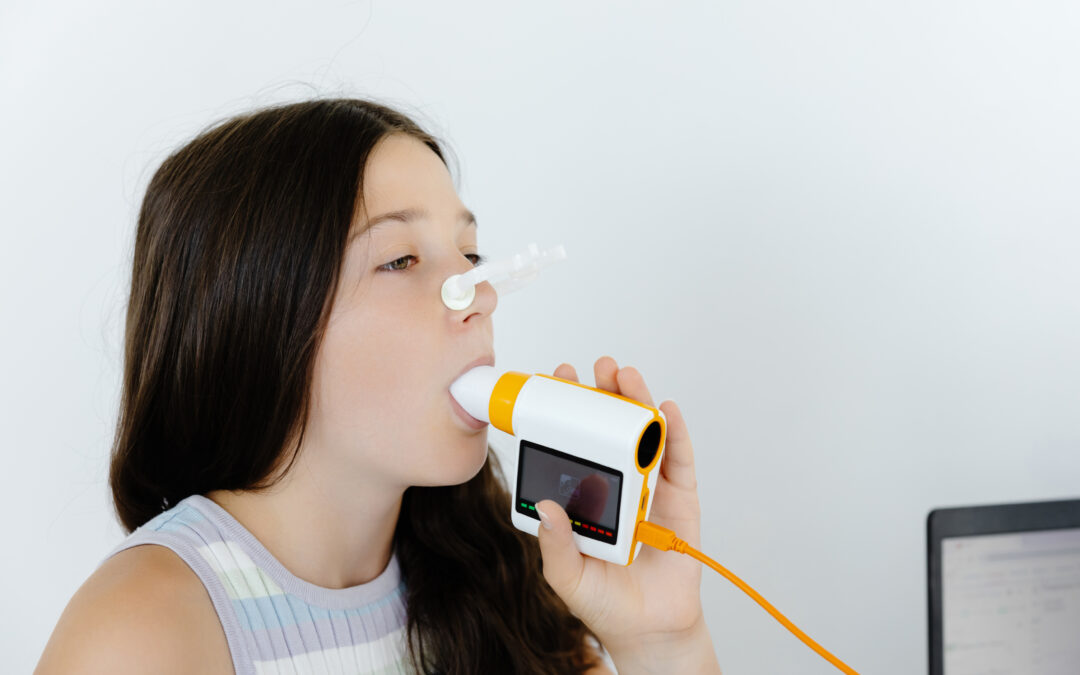
Pillar 2, Airway Obstruction – Spirometry performed, FEV1 prebronchodilator is 72% predicted, post bronchodilator shows an increase of 9%, which is clinically not significant.
Pillar 3, Inflammation – FeNO is 58ppb. FeNO greater than 50 ppb is considered high in adult patients. Blood eosinophils (EOS) are 400 cells/µL. Normal levels are 30-350 µL, so her EOS level is also high.
Let’s assess what we know so far. Is this asthma? Could the ICS/LABA/LAMA and prednisone effect the current test outcomes? Yes. Do the results we have so far confirm or rule out asthma? Not completely. We do not see a 10% increase in FEV1 would provide some assurance towards an asthma diagnosis, but there is no improvement. Is there inflammation? Yes, as highlighted by her elevated FeNO and blood eosinophils. Keep in mind her treatment regime: ICS/LABA/LAMA, anti-IL5 biologic and oral prednisone.
Pillar 4, Airway Hyperresponsiveness – a methacholine challenge with Provocholine® is performed following the ATS short/quadrupling dosing schedule.3 The patient’s PC20 is 4.2mg/mL, she has a positive methacholine challenge. The outcome of the methacholine challenge supports ruling asthma in.6
Our patient does have asthma; likely severe refractory asthma. She cannot stay on prednisone long term but cannot wean below 5mg/daily without experiencing increased shortness of breath.
This case study highlights the importance of objective testing in making treatment decisions. When looking at biomarkers for treatment decision making, elevated FeNO directs us to consider medications which block IL 4 or IL13. These types of biologic medications will help reduce nitric oxide production which coincides with decrease airway inflammation. An anti-TSLP biologic should also be considered. This medication can reduce blood eosinophils and FeNO, which come from IL-5 and IL-13 pathways, and total IgE.
Our patient was switched to a TSLP monoclonal antibody medication. At her six week follow up visit her FeNO and blood eosinophils were decreased and her ACQ was 0.5.
Objective testing is not just for diagnosis; it is essential throughout asthma management. Regularly reassessing the four pillars—symptoms, airway obstruction, airway hyperresponsiveness, and airway inflammation—provides the evidence needed to determine whether treatment is working and whether the diagnosis and therapeutic strategy remain appropriate. Before escalating medication, pause to review the full clinical picture, repeat objective measurements, and use the results to guide the next step. This disciplined approach reduces unnecessary treatment, supports timely and targeted adjustments, and keeps every decision focused on achieving the best possible outcome for the patient.
Author:
Heather Murgatroyd, BA, RRT, CPFT, AE-C
Senior Clinical Specialist
Methapharm Respiratory
References:
- D. Aaron, K.L Vandemheen, et al. Reevaluation of Diagnosis in Adults with Physician-Diagnosed Asthma. JAMA. 2017 Jan 17;317(3):269-279
- Expert Panel Report 3 (EPR-3): Guidelines for the Diagnosis and Management of Asthma-Summary Report 2007. J Allergy Clin Immunol. 2007 Nov;120(5 Suppl):S94-138.
- PROVOCHOLINE® package insert, revised 2/2023
- Khatri, J. Iaccarino, et al. (2021) American Thoracic Society Documents. An Official ATS Clinical Practice Guideline: Use of Fractional Exhaled Nitric Oxide to Guide the Treatment of Asthma.
- American Thoracic Society. https://www.thoracic.org/members/assemblies/assemblies/srn/questionaires/acq.php
- Coates AL, Wanger J, Cockcroft DW, et al. ERS technical standard on bronchial challenge testing: general considerations and performance of methacholine challenge tests. Eur Respir J 2017; 49.